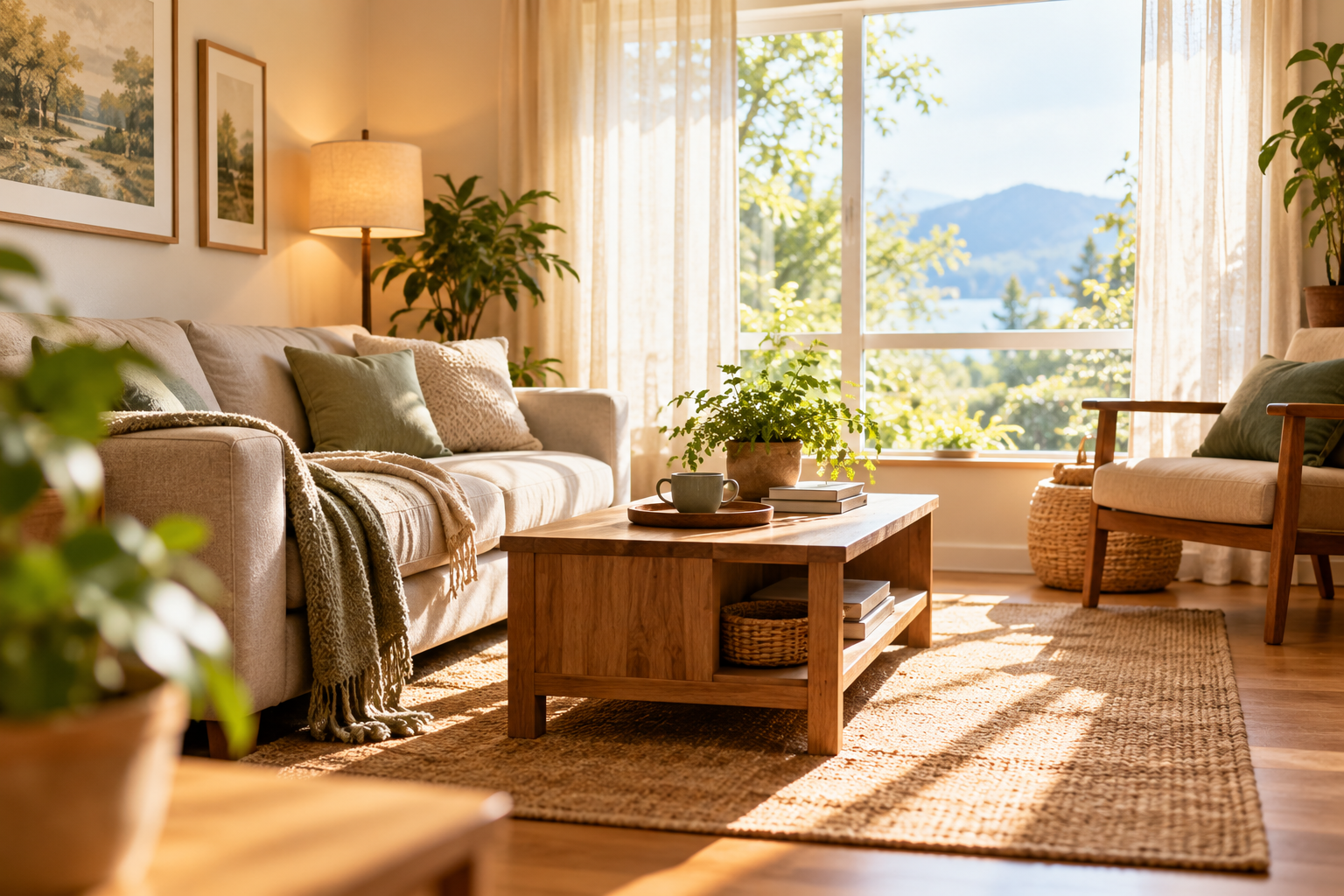
A small living room does not necessarily need more square footage.
Sometimes it simply needs to make better use of the space it already has.
Before thinking about renovations, knocking down walls, or replacing everything in the room, it can be worthwhile to look again at what is already there. Colour, light, furniture placement, pathways and even the empty spaces between things can change how a room feels.
Some of these changes cost nothing at all.
Others may involve choosing one useful item that solves a genuine problem.
Here are seven places to begin.
1. Use Colour to Create Visual Space
Colour can dramatically change our perception of a room.
Lighter colours tend to reflect more available light, which can help a smaller room feel brighter and more open. Soft whites, warm neutrals, pale greens, gentle blues and other lighter shades can all work well.
But that does not mean every small room should be painted white.
A room with plenty of natural light may comfortably carry a deeper colour. A darker room might benefit from something warmer rather than simply brighter. The important thing is to consider the light that actually exists in your room.
Contrast matters as well.
Strongly contrasting walls, trim and ceilings can create visual boundaries. Using colours that relate more closely to one another can allow the eye to travel more easily through the room.
Before painting the entire room, try a sample and observe it at different times of day.
Morning sunlight and evening lamplight can make the same colour look surprisingly different.
2. Let Natural Light Travel
A window provides more than a view.
It can change the character of the entire room.
Heavy curtains, furniture placed directly in front of windows, large plants and accumulated objects can unintentionally block natural light.
Take a look at your windows from across the room.
Is anything preventing that light from travelling farther into the space?
Sometimes moving one chair or removing one unnecessary object can make a noticeable difference.
Window coverings can help too. Lighter curtains or blinds that open fully allow you to control privacy without permanently sacrificing daylight.
A strategically placed mirror can also reflect existing light into another part of the room.
The important word there is existing.
The mirror isn’t creating light. It is simply helping you make better use of what is already there.
That sounds rather familiar.
3. Create Clear Pathways Through the Room
Every room has invisible pathways.
We walk from the doorway to the sofa.
From the sofa to the kitchen.
From a chair to the window.
When furniture interrupts those natural routes, even a reasonably sized room can begin to feel cramped.
Stand at the entrance to your living room and notice where you naturally want to walk.
Do you have to step around a coffee table?
Squeeze between a chair and sofa?
Walk around furniture that rarely gets used?
You may not have a space problem.
You may have a placement problem.
Try moving things before replacing them.
A few inches can sometimes make more difference than another piece of furniture ever could.
4. Give Furniture More Than One Purpose
In a smaller room, furniture has to earn the space it occupies.
A coffee table that is only a coffee table may be perfectly appropriate.
But if storage is a problem, perhaps that same amount of floor space could provide both a table and hidden storage.
An ottoman might provide seating, storage and a place for a tray.
A small side table could include drawers or shelves.
A console could provide storage while also defining an entry area.
Nesting tables can appear when they are needed and tuck away when they aren’t.
This is where buying something new can actually make sense.
The goal isn’t to squeeze clever furniture into every available corner.
It is to ask:
Can one useful object do the work of two?
If it can, we may be able to remove something else.
5. Use Vertical Space Before Adding More Furniture
When we run out of storage, we often look across the floor.
Perhaps we should look up.
Walls are one of the most underused areas in many small rooms.
Shelving can provide storage or display space without consuming the same floor area as another cabinet or bookcase.
Wall-mounted lighting can sometimes replace a floor lamp or free space on a side table.
Hooks and carefully positioned wall storage can give everyday objects somewhere to belong.
There is a balance here.
Covering every wall with storage can make a small room feel even more crowded.
Use the walls because they solve a problem — not simply because they are empty.
6. Remove Before You Organize
This may be the least expensive suggestion in the entire article.
Before purchasing baskets, containers, shelving units or organizers, look at what you are actually trying to organize.
Do you still use it?
Do you still enjoy having it?
Does it belong in this room?
Could it live somewhere else?
Sometimes we purchase storage to organize things we don’t need.
Then we have both the original things and the new storage system occupying our limited space.
Removing one unnecessary item costs nothing.
And unlike another organizer, it creates actual space.
Once you know what genuinely needs to remain, then storage products can become useful tools rather than another source of clutter.
7. Leave Some Space Empty
This one can feel strange.
Particularly in a small home.
When space is limited, an empty corner can look like wasted potential.
Surely something should go there.
A shelf.
A plant.
A chair.
A cabinet.
Perhaps.
But perhaps not.
Empty space gives us somewhere to move. It allows light to travel. It gives objects separation and gives our eyes somewhere to rest.
This is something we explored in The Space Between Things.
A room is shaped not only by the objects within it, but by the relationships between those objects — including the open space surrounding them.
So before filling an empty corner, try living with it empty for a while.
You might discover that the corner is already doing something valuable.
It is giving you room.
Start With What You Already Have
You don’t have to do all seven of these things.
Choose one.
Move a chair.
Open the curtains.
Remove something you no longer use.
Try a different furniture arrangement.
Look upward for storage rather than automatically adding another cabinet.
Or simply stand in the doorway and look at your living room as though you were seeing it for the first time.
Only after doing that should you ask whether buying something would genuinely improve the space.
Sometimes the answer will be yes.
A better lamp, the right shelving, a storage ottoman or a more appropriately sized table might solve a real problem.
And when it does, it is worth considering.
But sometimes the answer will be much simpler.
You may already have enough.
You may simply need to make a little more room for the room you already have.